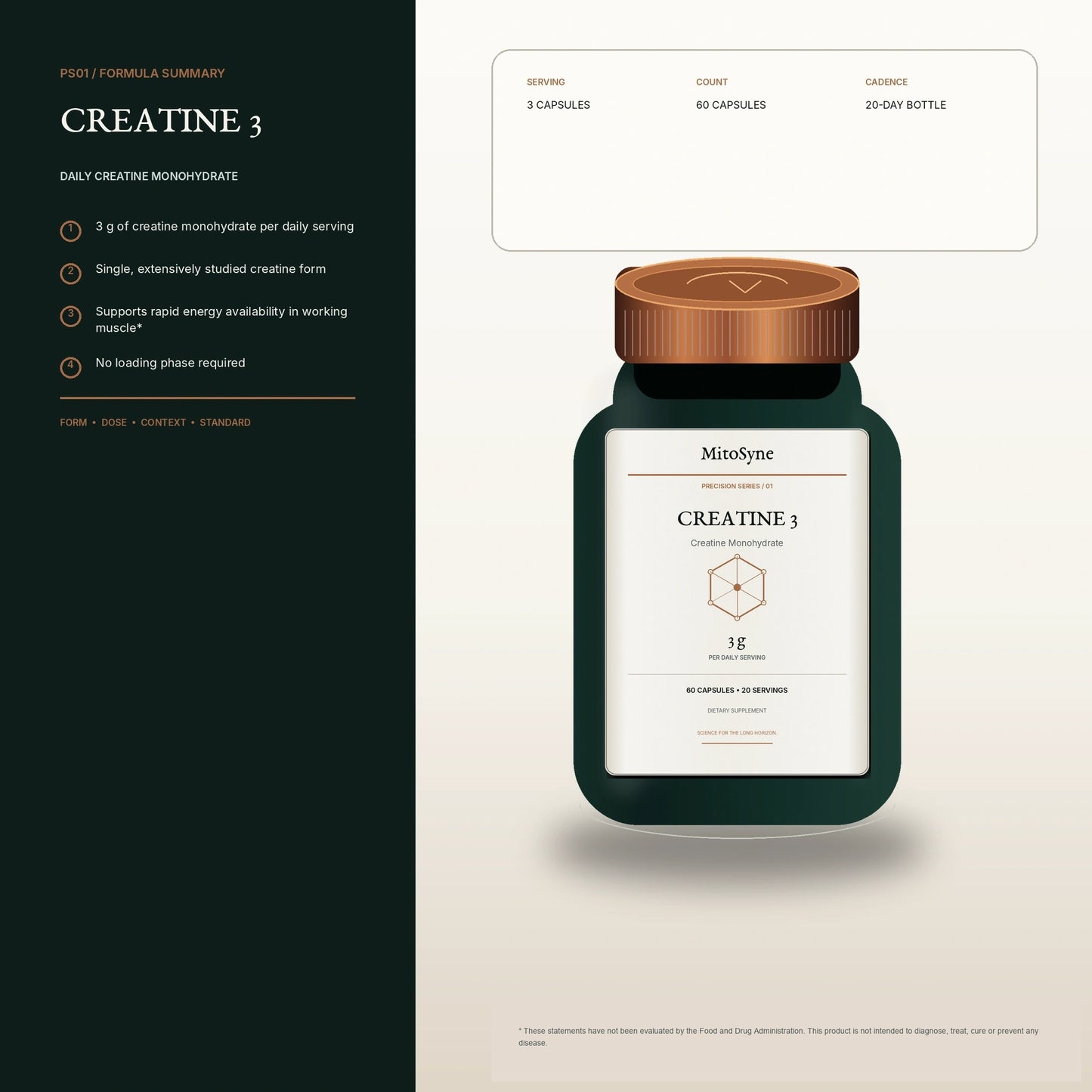
Creatine Monohydrate
- Category
- Active ingredient
- Label information
- 3,000 mg
- Details
- Creapure® micronized creatine monohydrate
Creatine Monohydrate | 3 g
Supports phosphocreatine availability, repeated high-intensity performance and consistent daily creatine intake.
Couldn't load pickup availability
Formula overview
A precise 3 g daily serving of creatine monohydrate in a no-loading capsule format for people who want one of the best-characterised ingredients in sports and cellular-energy nutrition without a powder tub.
Active form
Creapure® micronized creatine monohydrate
The three-capsule format delivers the full daily amount without a blend or loading protocol.
Intended role
Supports phosphocreatine availability, repeated high-intensity performance and consistent daily creatine intake.
Creatine monohydrate has one of the deepest human evidence bases in supplementation. The clearest benefits concern strength and repeated high-intensity performance when paired with training. Cognitive evidence is promising but more variable; recent syntheses suggest possible benefits for memory and selected processing outcomes, with stronger signals in older, stressed or lower-creatine populations.
Interactions
No major interaction is established for healthy adults, but kidney disease, dehydration risk, diuretics or medicines affecting renal function justify clinician review.
Three capsules are required to deliver the full 3 g serving within a 60-count format. Reducing the serving to one or two capsules would create an under-dosed product.
No. Consistent daily intake can raise tissue creatine over time without a loading phase.
Creatine can increase intracellular water and body mass. That is a known physiological effect rather than proof of fat gain.
No. The strongest evidence concerns physical performance, but creatine is also being studied in older adults and cognitive contexts. Those findings should not be overstated.
Creatine is commonly used alongside protein-containing foods or supplements. Total diet and training remain more important than timing.
Continue exploring
 MitoSyne Taurine 1000 — Taurine, 1,000 mg$50.40 USD
 MitoSyne Omega-3 1100 — EPA + DHA Omega-3, 1,100 mg$54.60 USD
 MitoSyne D3 + K2 — Vitamin D3 + Vitamin K2 MK-7, 50 + 90 mcg$52.80 USD